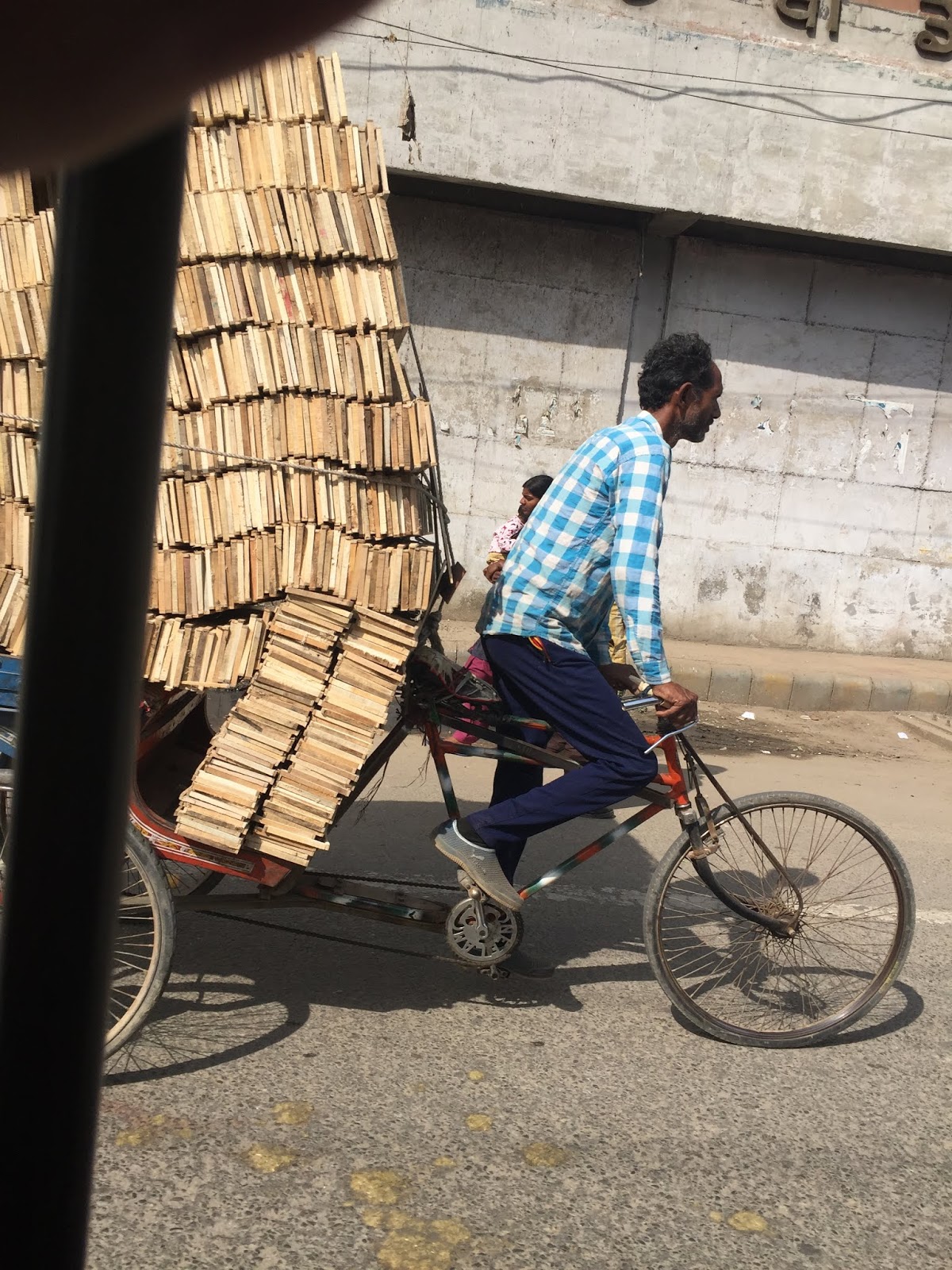
INDIA, AT LAST
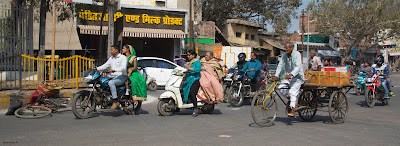
If someone asked me to sum up India in one phrase, I’d
say it’s an unadulterated assault on the senses, all of them, all the
time. And that’s not necessarily a bad thing. As photographers, we travel to capture a moment, a color, a scent, a scene we want to never forget. We travel to satiate the senses and India meets all of those requirements, whether you went in search of them or not. It's huge and overwhelming and full
of in-your-face experiences - and almost all the stories we hear in the hostels around the world
are true. In the dark alleys of Varanasi, I walked headlong into a holy cow so I will be adding my own
to the plethora of tales that either make people want to go again or keep them away forever.
I finally get it. India really is like nowhere else. The
touts are legendary, the beggars are abundant, the old men covered in
the ashes of their dead descendants who
try to paint your forehead or read your palm are everywhere. The food is
some
of the best I’ve ever had. The lassies are out of this world and, for my
part, entirely impossible to duplicate once you leave the country. The
moment I left, I knew I would be coming back. India is in my blood now,
possibly along with various parasites. If only I didn't love street food
so much... so here we go. Enjoy!
For my friend, George and I, the journey started in Delhi. We arrived on a day when the pollution was so thick that some airlines had actually
cancelled flight because they did not want to expose their personnel to the
poor air. Our hostel was Raj Villa, a pretty nice place on a - for India -
fairly quiet street in the Paranganj district with plenty of little eateries
serving freshly cooked meals for mere pennies.
 |
| View from our room: autorickshaw serves as a good place for a nap in the midday heat |
For any foodies reading this,
don't ever skip the chance to have chana masala or dal makhani. If you're a
coffee lover and like me prefers to eat in tiny hole-in-the-walls, I hope you
like it white and very, very sweet. This is not a country that skimps on sugar. The
chai tea is absolutely fabulous and leaves you thinking you will never again be satisfied with any mediocre version served up back home.
Delhi is fascinating. Everything seems to be perpetually in motion. It's a bit quieter at
night but not by much. Despite the noise, the pollution, the poor condition of
the streets, the non-existing rules of the road and the constant "music" of
blaring car horns, I really liked it. People were for the most part more
friendly that most other large city dwellers and of course the food was amazing. Everything moves with a vibrant madness. It was not as dirty as I
had expected either, probably in part because of the "Clean Up India"
program that was launched by the government a few years back.
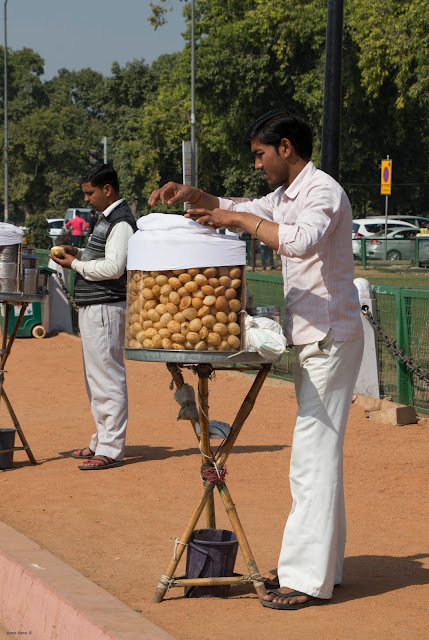 |
| Puripan vendor at India Gate |
Since we only had a
few days in Delhi, we decided to go through an agency and book a two day tour
that would take us to Agra to see the Taj and then to Jaipur to see the Red
Fort. The agency threw in a "free" day with Mr. Singh,
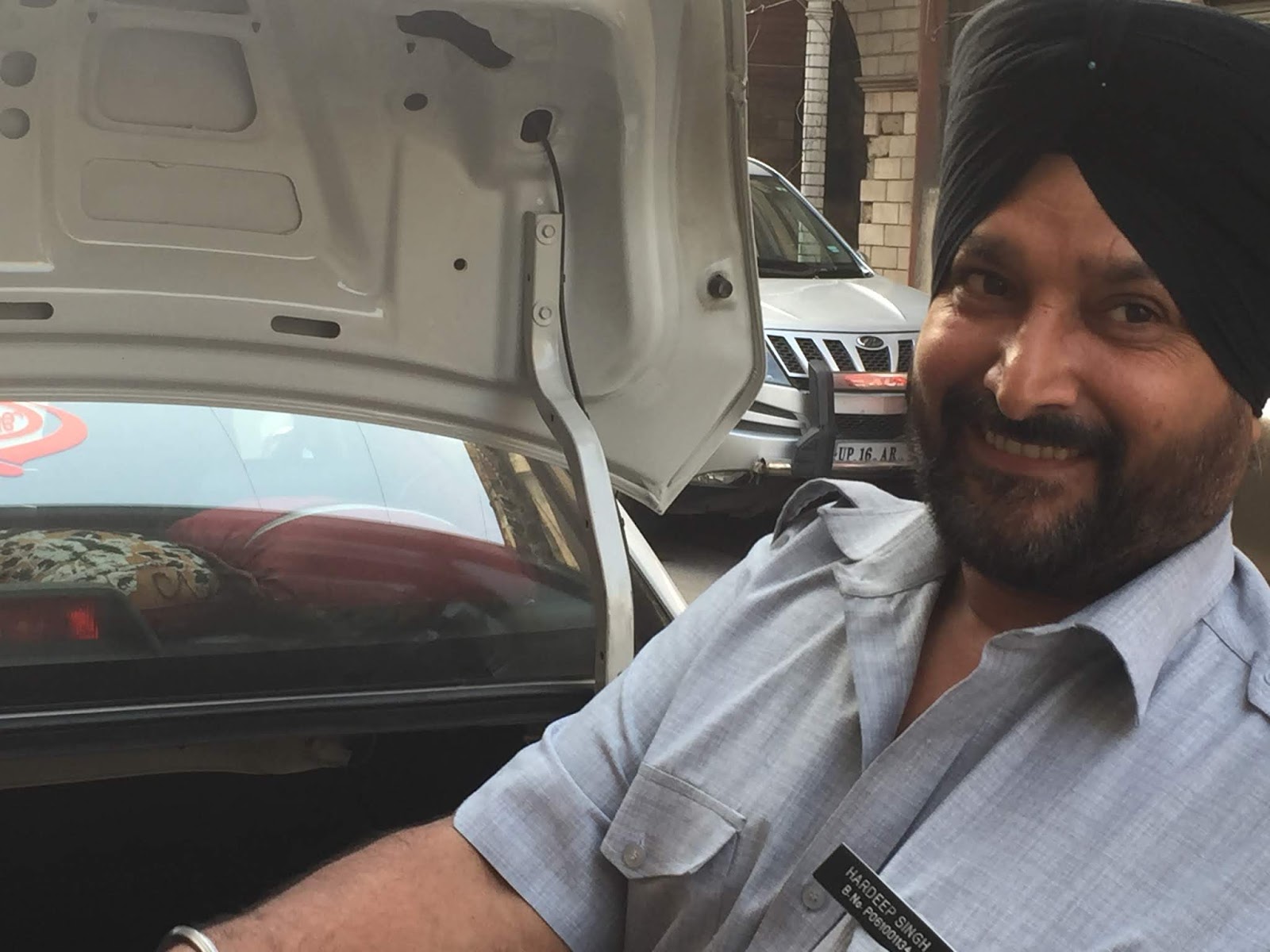
whom we fondly ended up calling our Good Mr. Singh. He was a short Sikh with a
beautiful black turban. He worked as a taxi driver and picked us up the
following day at the hostel and took us on a city tour to Birla Mandir (Hindu
temple), which was very beautiful, the Prime Minister's complex and then to
India Gate.
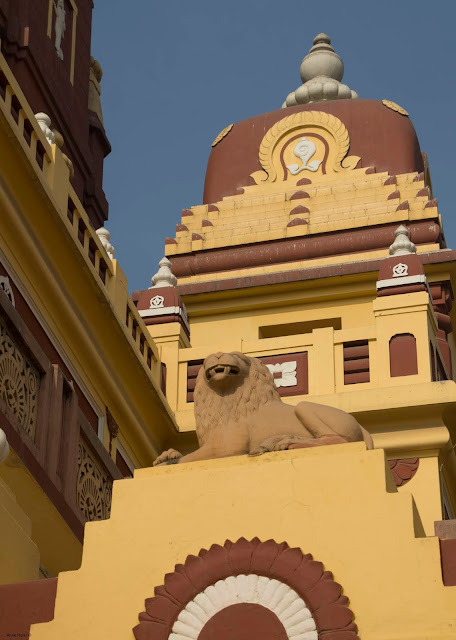 |
| Birla Mandir temple |
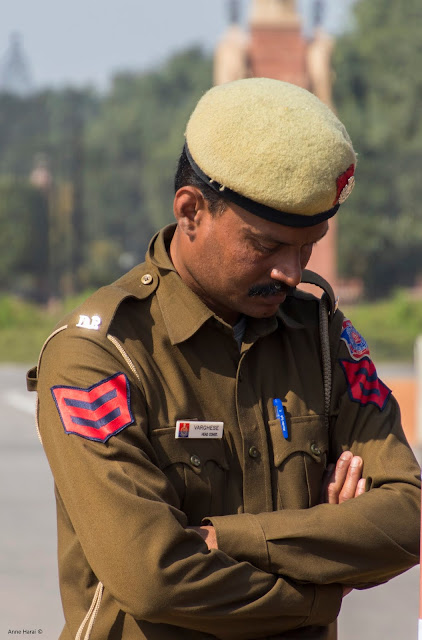 |
| Napping in the midday heat outside the Prime Minister's house |
India Gate, a memorial to the soldiers who died in the First World War and the Third Anglo-Afghan War, is a popular destination for the sightseeing buses, evidence by
the swarms of touts selling everything from jewelry to balloon animals; we
spent a very brief time there and instead asked Mr. Singh to take us to the
Lodhi Gardens, which were beautiful and much less crowded.
 |
| Street vendor at India Gate |
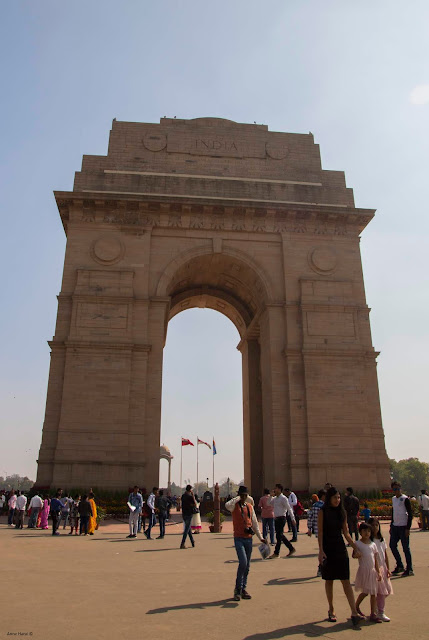 |
| India Gate |
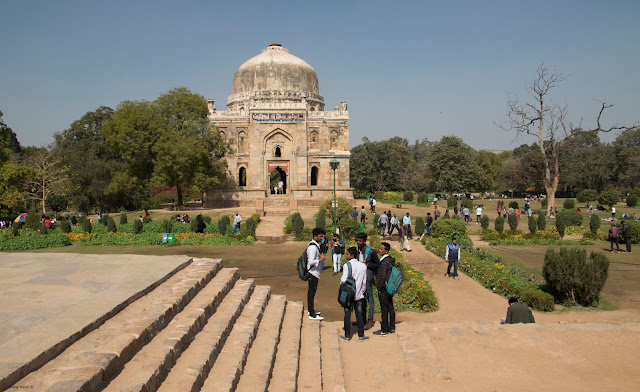 |
| Sheesh Gumbad, Lodhi Gardens |
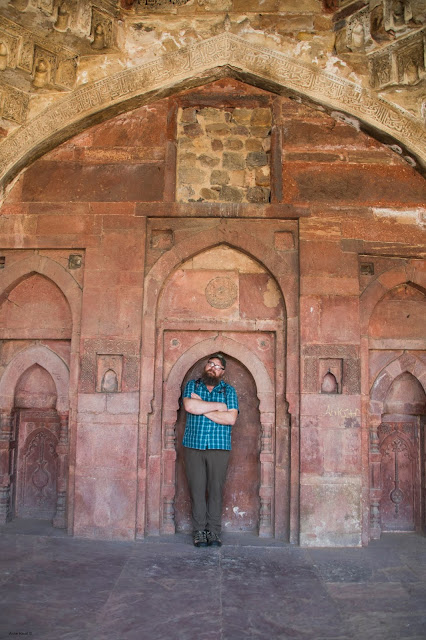 |
Bada Gumbad Complex, Lodhi Gardens
|
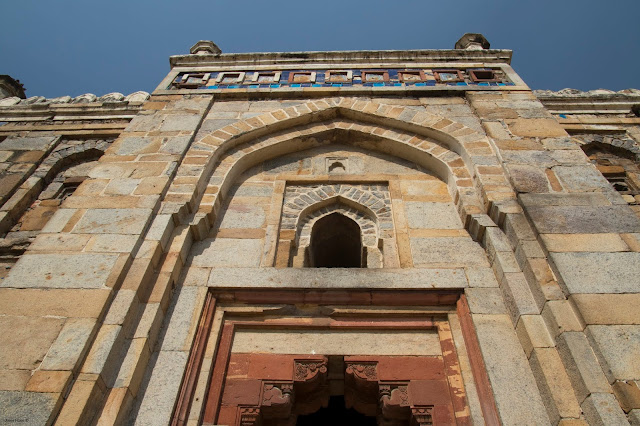 |
| Lodhi Gardens Complex |
Of all the things we
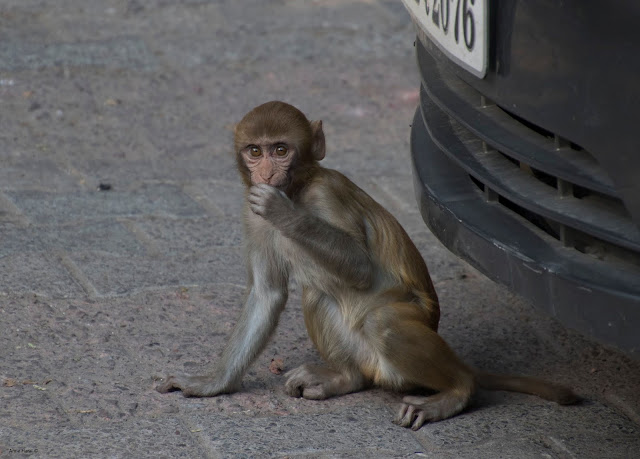
saw, I have to admit I was most taken by the wily little street monkeys. Like scabby little ghosts they skittered along roof lines, fences and telephone poles, completely unaffected by the insanity around them. This wee chum was hanging out in the parking lot of the National Art Gallery. I wanted to take him home.
Our Indian Odyssey road trip
started the following morning and Mr. Singh was only an hour late, which I think
is pretty good by India standards. Many hours and a delicious lunch of aloo
parantha later, we arrived in Agra. Holy cow. It was an absolute mob scene of
locals and giant tour buses and thousands of Indian tourists coming to see the
palace. Since the traffic was so horrible, Mr. Singh parked his taxi and we were guided into an autorickshaw that took off like a bat out of Hell down the narrow alleys, people and cows and goats zooming by in a blur.
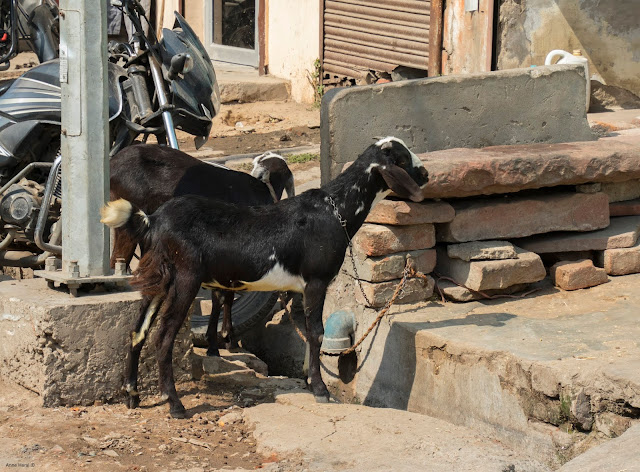 |
| Omnipresent Indian street goat |
Once we got to the palace complex, I was ushered into the ladies-only line - this takes some getting used to but it happens at the airports, too - while George took
the men-only line. Fortunately we ended up in the same place. Despite the harrowing arrival, the hordes of visitors and the heat, it was hard not to be impressed. The Taj
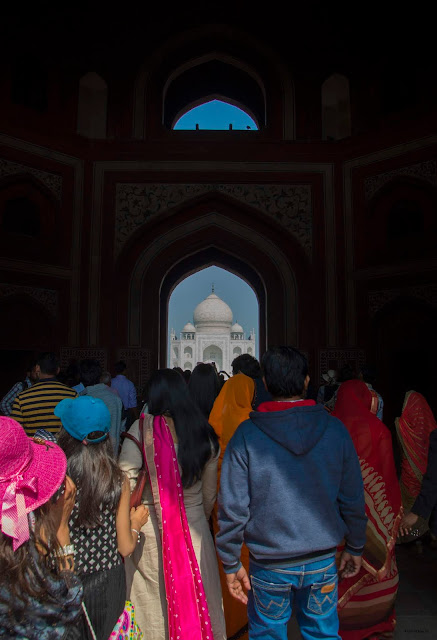
Mahal, built in the 17th century by Mughal emperor Shah Jahan as a mausoleum for his favorite wife, was a sight to see. From a photographer's standpoint, the thousands of Indian visitors in their
beautiful bright saris trimmed in gold, their ankles, neck and wrists adorned with the latest designer jewelry, were of course equally intriguing. At the Taj, I realized that Indians love to visit India as much as us foreigners.
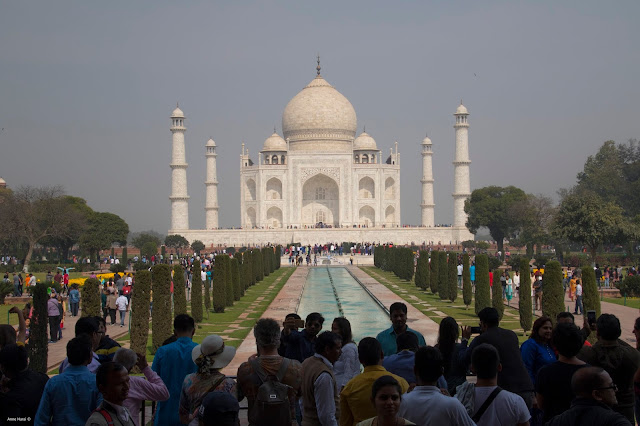 |
| The Taj and a hazy sky |
 |
| Kau Ban mosque |
 |
| It's all about the color! |
We spent the night
in Jaipur, after a 5 hour drive from the Taj Mahal past endless fields of
mustard, cows and garbage along the road. Instead of the prescribed hotel
continental breakfast, we opted for local fare and went down to where the
streets vendors were making fresh panipuri, a hollow shell of fried dough with sweet coconut or other stuffing
inside. Delicious!
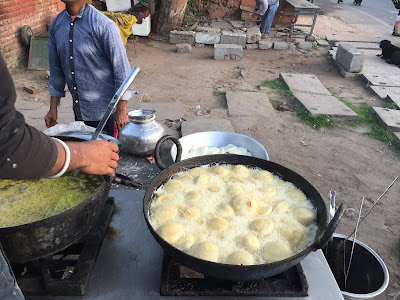 |
| Breakfast coconut panipuri |
 |
| Saffron bars |
My favorite part of
the day was the Panna Meena Ki Baori step-well on the way up the narrow road leading
to the Amber Fort, an exquisite design of symmetrical steps ending in a well at
the bottom. It was built by Brahmin in the 16th century and used to collect rain water for bathing, washing clothes and household use. Of all the architectural sight we saw this was the most impressive and there was not even a fee to get in.
Continuing up the road, we discovered a
small pack of Hanuman monkeys on a roof top and had Mr. Singh pull over so I
could take pictures. With my non-existent Hindi and Mr. Singh's very limited
English, I managed to explain that monkeys are a favorite subject and the guide
we had unwittingly been assigned helped to bridge the gap. So we brake for
monkeys,yes, Mr. Singh? Okay okay. Big smile.
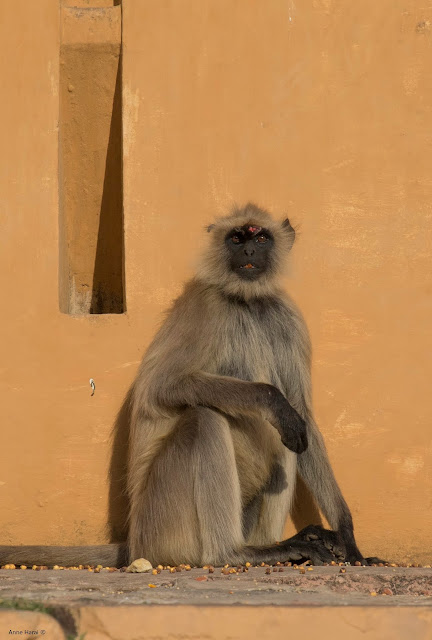 |
| Slightly battle worn |
I'm bit of a sucker for architecture and on that note, the Amber Fort was beautiful. The view atop the citadel are lovely and, bonus, you get to
poke fun at all the tourists who ride elephants to the top. If you see only one fort
in India, and there are many, I suggest this one. The Mogul architecture is
stunning, the mosaics intricate, the gardens are beautiful and well-maintained,
and the play of light among the store details is fascinating. Equally beautiful
were the women in charge of sweeping the grounds in their matching orange saris
and homespun sandals. After a couple of hours, we were off and caught more
monkey shots on the way down.
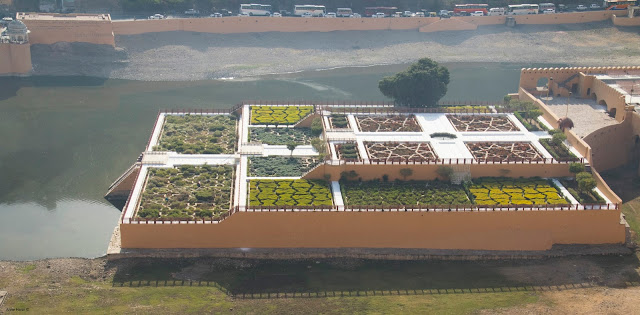 |
| The Queen's Garden |
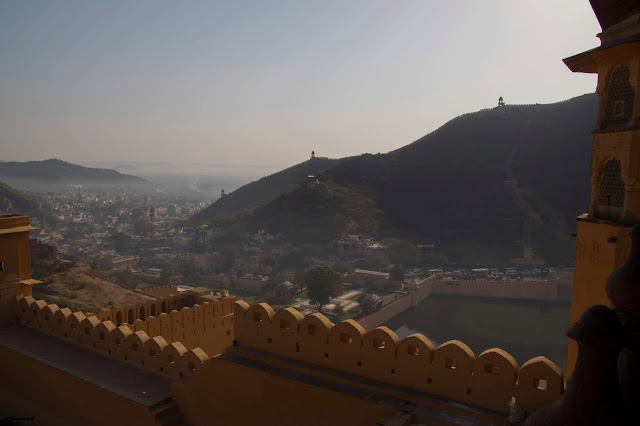 |
| View from the top |
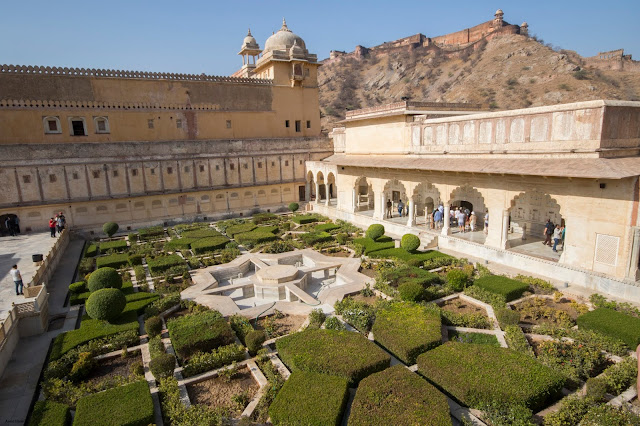 |
| The inner gardens |
We were taken to a shop that dealt with inlaid
wood, but managed to escape unmolested and with no purchases in tow. This last
bit of any tour is often as mandatory as it is unpleasant, though not
surprising, and the prices are of course far inflated from anything you could
get in a normal street market. Besides, I really did not need to drag around a
coffee table for the next four weeks, however many hours it had taken them to
finish it. The guide fortunately left us at this point and we continued onward towards
Delhi with our Good Mr. Singh and his
very few words. At the end of the journey, he got a nice big tip since his
primary contribution, besides driving, was politely pointing out various sites
along the road but then saying very little otherwise. I hope everyone who goes to Delhi meets Mr. Singh. I cannot
recommend him enough.
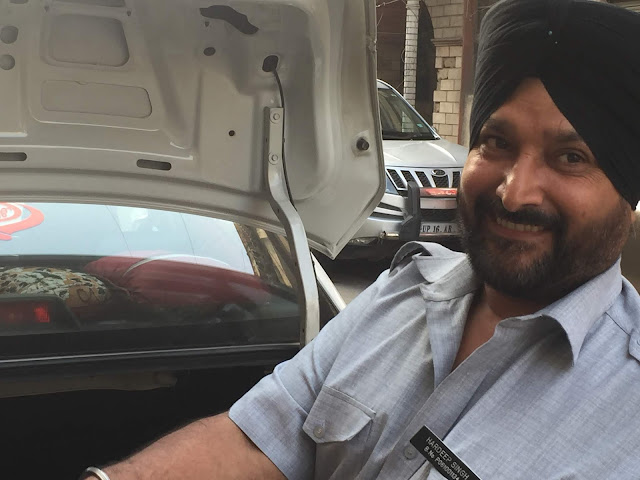 |
| The venerable Mr. Singh, most revered driver in Delhi |
Back at the hostel, our prescribed porter asked us in a
whisper if we would like cold beer, not to be turned down, and it was delicious
although he was not actually allowed to serve us on the premises. One of the
local brews, Kingfisher is a very decent lager and it was about as close to
cold as anything in India.
The following day
we were off north on the train to Chandigarh and Mr. Nek's rock garden. We made
it through the myriad of touts and autorickshaw drivers, "Miss, you want
ride," and ended up on the right platform with the right tickets to third
class with actual assigned seats. I had
a couple of cups of Nescafe with so much sugar added the spoon actually stood
upright, but in a pinch it was still coffee. Third class apparently came with a
meal, consisting of European crackers, tea, crustless toast and pakora -
interesting combination. After hearing many horror stories of Indian trains, I have
to confess I have none to add. It was a very pleasant experience, even in the middle
classes.
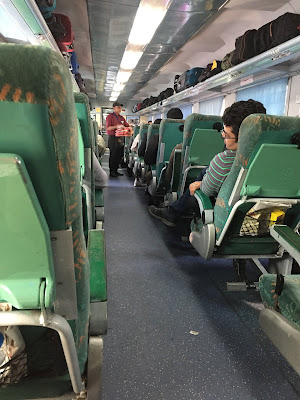 |
| Third class splendor |
We arrived in
Chandigarh a few hours later, only to find that the hostel I had booked did not
accept foreigners. Huh? We tried a few more - same issue - until we finally
found one for the bargain price of 1200 rupees, humorously named The White
House. We would only be in Chandigarh one night, since we just wanted to see
the rock gardens, before moving on to Amritsar.
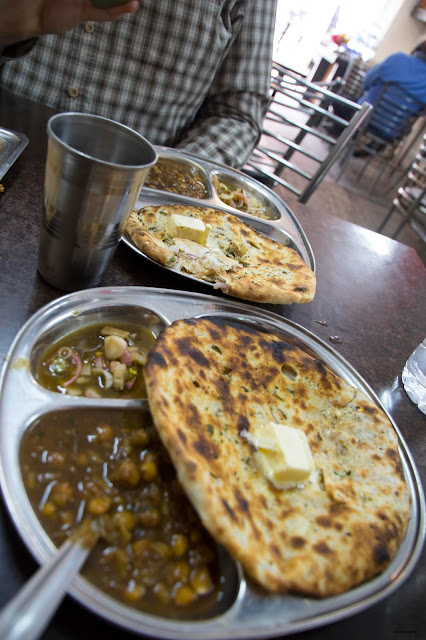 |
| Yet another splendid meal |
With a whole afternoon free, we had
time for a good lunch at a tiny eatery where we had masala and roti, before
catching an autorickshaw to the gardens. Now, I should say that "garden" is used very
loosely here. Mr. Nek, now deceased, created a sculpture wonderland of sorts
that really only pictures can described - so see below and enjoy the genius of
this slightly mad artist.
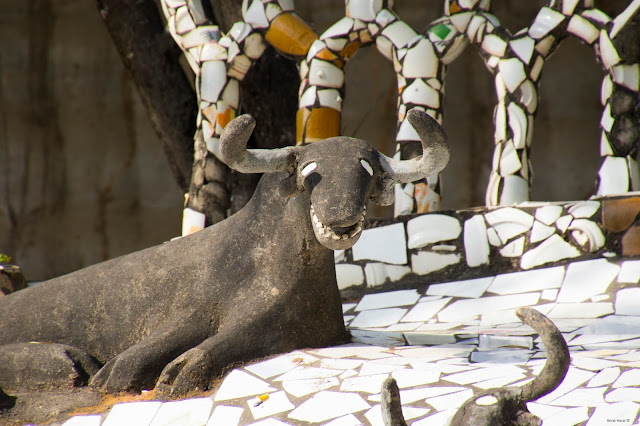 |
| La vache qui rit, Indian style |
 Fascinating place
and a true bargain with the 30 rupees entry fee. Highly recommended and you really
don't have to love gardens to see it.
What I should mention is that if you're
white, you will inevitably be featured in a number of Facebook pages,
possibly in some sort of national competition of who can collect the most pictures of
themselves paired up with some unknown person of non-Indian descent. You get used to is. Plaster on a nice big smile, and then hold
out your hand for a few rupees which just elicit blank stares. Interesting
place, this India.
Fascinating place
and a true bargain with the 30 rupees entry fee. Highly recommended and you really
don't have to love gardens to see it.
What I should mention is that if you're
white, you will inevitably be featured in a number of Facebook pages,
possibly in some sort of national competition of who can collect the most pictures of
themselves paired up with some unknown person of non-Indian descent. You get used to is. Plaster on a nice big smile, and then hold
out your hand for a few rupees which just elicit blank stares. Interesting
place, this India.
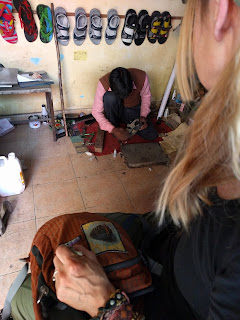
This was about the
time my sandal broke. I say that not because it's fascinating but for what followed. It has been decades since a cobbler
has been seen in my part of the world, but in India they are abundant. And as
such, there was one on the way back to our alley hostel. Showing him my shoe
and the flapping heel, and yes, those Keens were over a decade old and have been all over the world, he nodded
and fixed it in a matter of minutes. Admittedly, I had tried to put a piece of
bubblegum between shoe and detached sole, which he frowned at. Silly farang.
Anyway, it was glued and stitched and still holds. And it was 30 cents. Try
getting that in downtown Seattle.
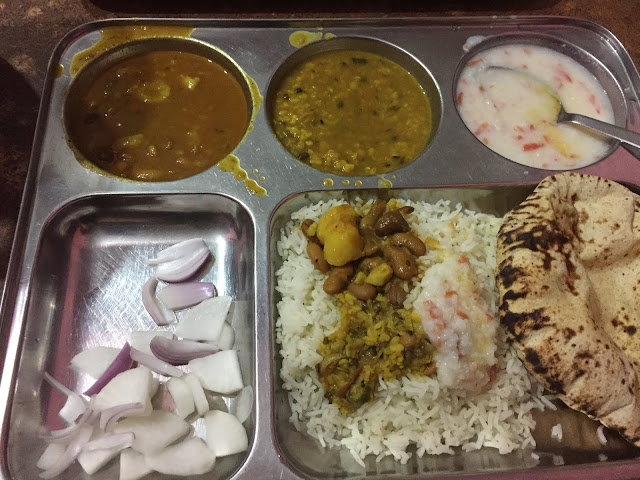 |
| Tastiest dinner in Chandigarh! |
The next morning we boarded the train to Amritsar, a predominantly Sikh state that borders Pakistan.
Going to see said border is a huge tourist attraction and millions of people stream up to see the changing of the guard, but we did not. I went to Amritsar to see the Golden Temple and it was worth every... well, actually it was free. It is the holiest Gurdwara and the most important pilgrimage site of Sikhism. The train ride from Chandigarh, BTW, was
about 3 hours for anyone wanting to go that route.
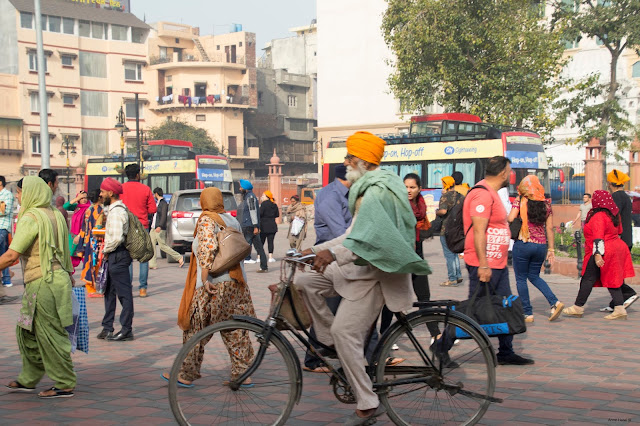 |
| Amritsar street life |
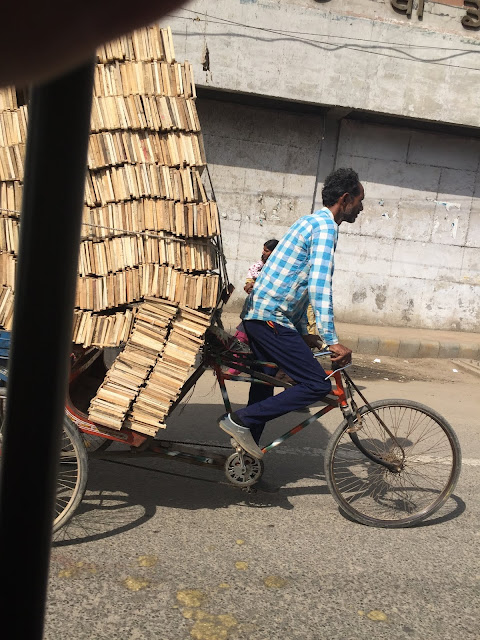 |
| Home Depot, Indian style |
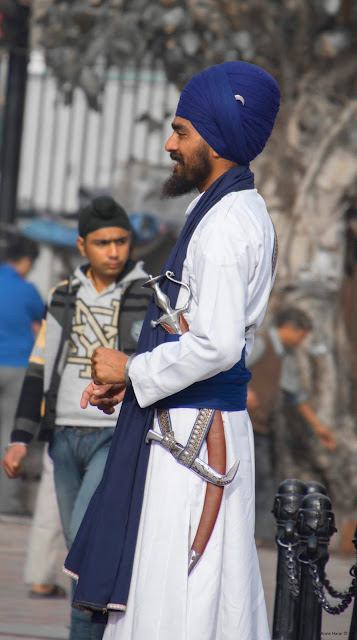 |
| Sikh guard with ceremonial dagger |
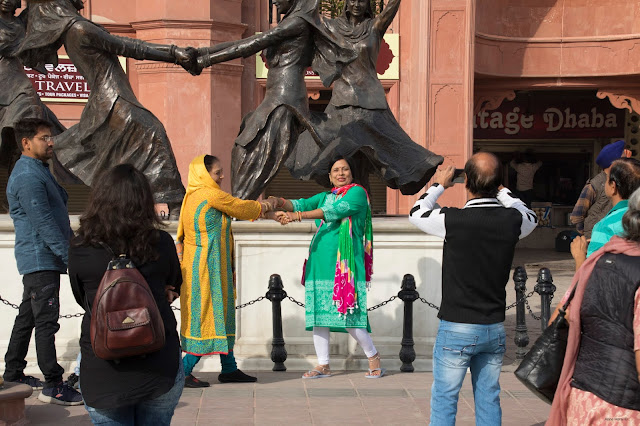 |
| Posing in front of the famous Dancing Women bronze statue |
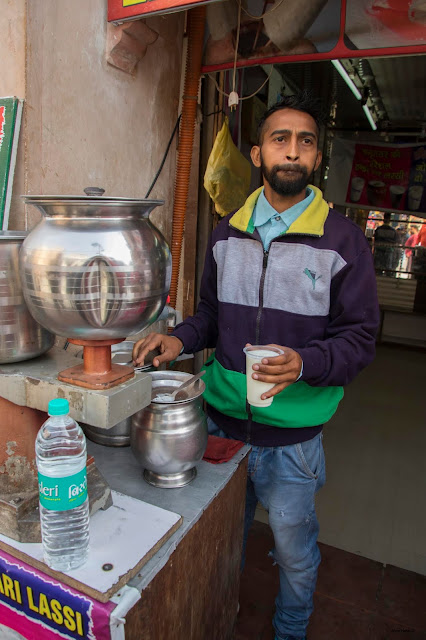 |
| Tastiest lassie in all of Amritsar |
By now, hot water
showers were a distant memory and we had gotten used to hostels telling us 'hot
water' and it being all but, so we were not surprised with our next lodging,
the Asha Guest House. Clean and dark, it was not bad, and we soon found an
excellent kulcha (leavened flatbread) restaurant right down the street. After yet another fabulous
meal, at the bargain price of two dollars,
we ventured out into the city. It was the usual chaotic craze but
Amritsar had a finer edge to it, though. It has a central pedestrian walk that
was obviously much "up-scale" from the side streets and there were lots of
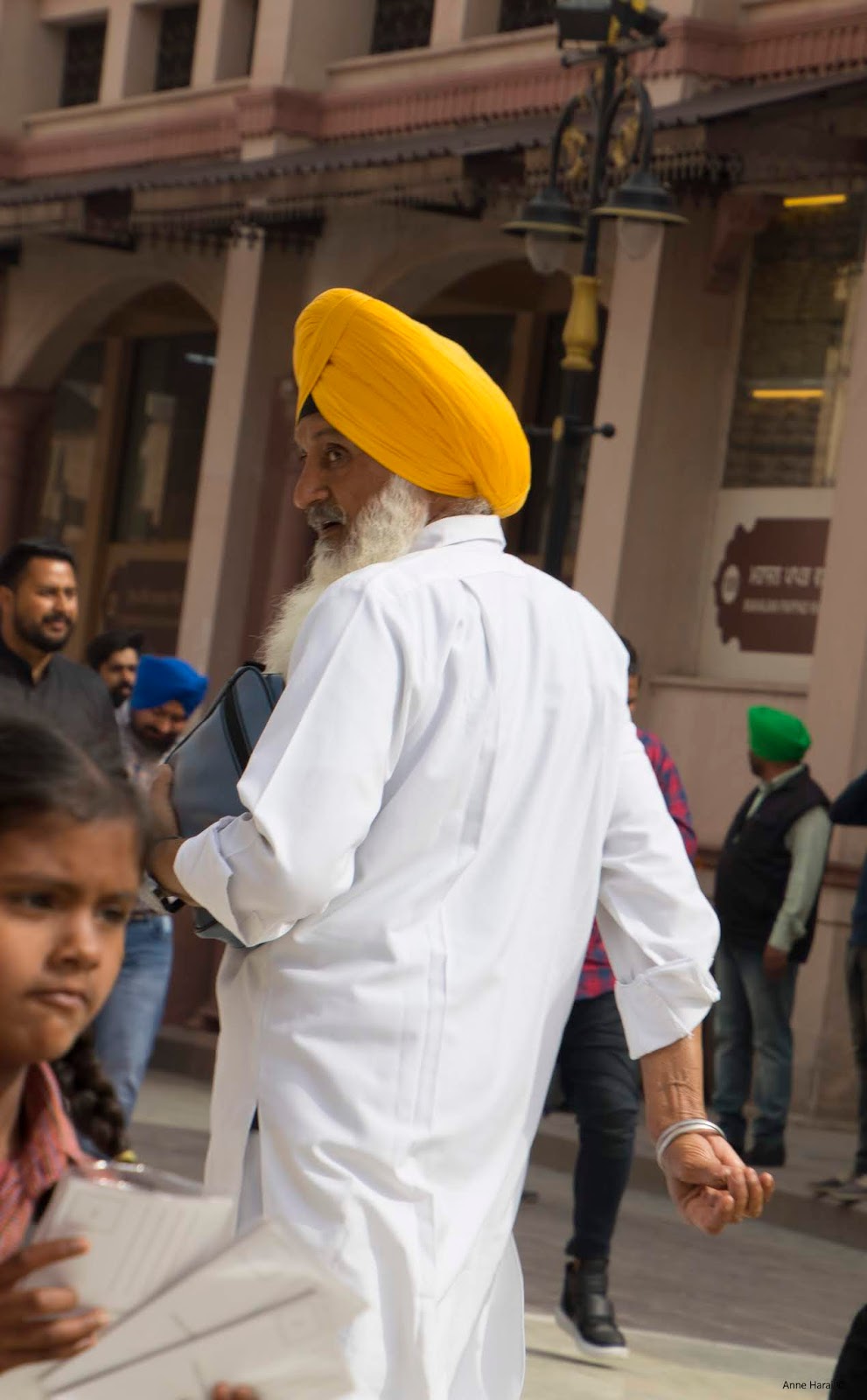
Indian tourists. I have never seen so many turbans, their bright colors like
lit lanterns bobbing on the breeze of a sea of people. There were more
backpackers here that in the other places we had visited but also the ubiquitous
loads of buses carting tourists around to packaged destinations with
checklists as long as my arm.
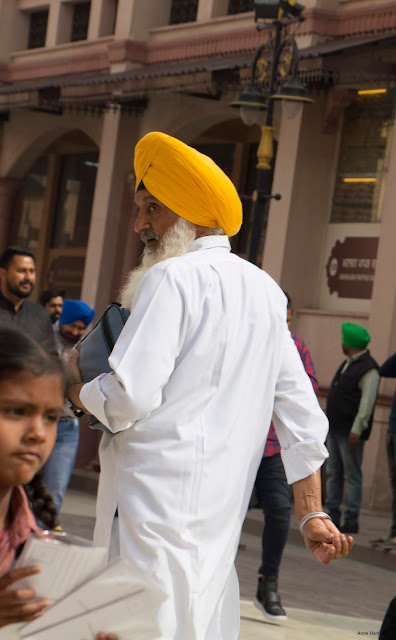 |
| Great place to people-watch |
We decided to just
wander around town, look at people, sample the local cuisine and take pictures
for the rest of the day, then meander over to the palace the following morning.
Amritsar is a very pleasant and easy place to wander around. The Sikhs are
polite, not pushy and seem to genuinely pleased that travelers take the time
to see their beautiful city. For my part, I by far preferred the Golden Temple to the Taj Mahal.
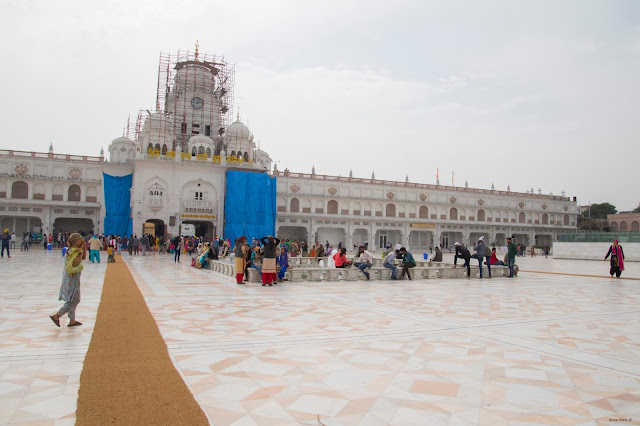 |
| The entrance to the temple complex |
The Golden Temple, completed by Guru Ram Das in 1577 and locally known as Sri Harmandir Sahib,
is a sight to see and especially at sunrise. After removing shoes and placing them in the
shoes deposit outside the temple grounds, immaculately garbed Sikh guards let
us in to the grounds along with myriads of devotees and the occasional
backpacker. A lot of people were performing the customary rituals in the sacred
pool surrounding the temple. Since we are not Sikh, we could not enter the
temple itself but that was fine. We walked around the square pool and just
people-watched. Once the sun climbed above the surrounding walls, the whole
building gleamed gorgeously.
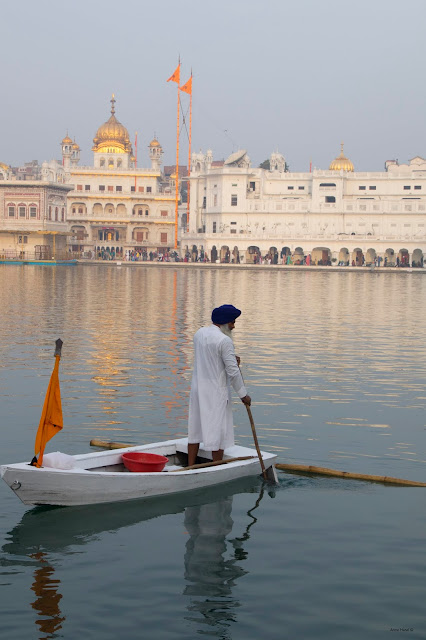 |
| Cleaning the sacred pool |
 |
| Temple guard |
We spent the rest of the morning rejecting offers
of 'border?', had very good aloo tikki at a little hole-in-the-wall eatery, and
went to Ram Bagh garden in the afternoon.
There was not all that much to see there, being the dry season, but we did see
a couple of Indian hornbills and there was a nice old dilapidated manor house now inhabited by green parakeets.
In the
evening we went to Waj Ji Waj for some excellent tandoori chaap that despite
being entirely vegetarian tasted just
like chicken.
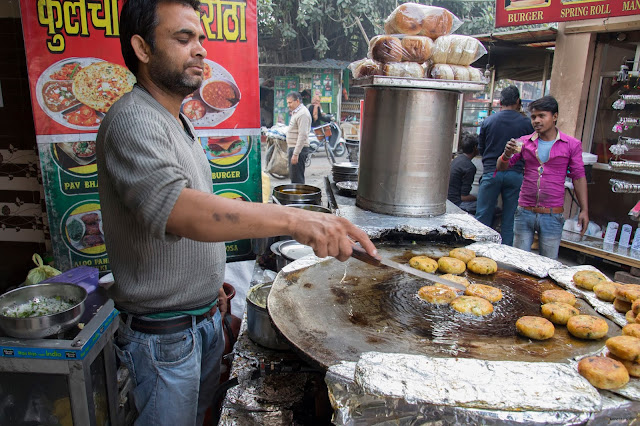 |
| Aloo tikki vendor |
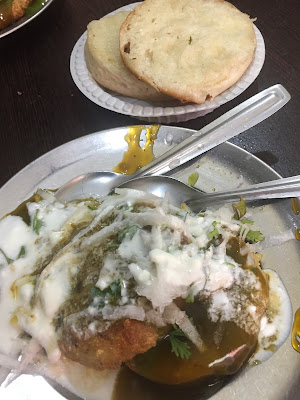 |
| Aloo tikki |
We flew to Jodhpur early the next morning. Aptly named the "Blue City," Jodhpur had long
been on the list of must-sees for both of us and it did not disappoint. It was founded in 1459 by Rajput chief Rao Jodha.
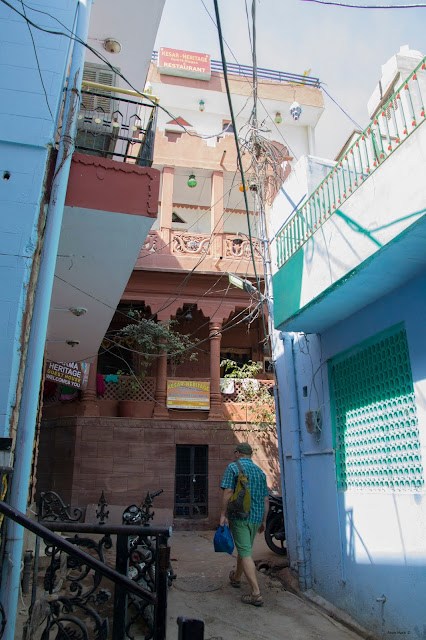 |
| Kesar Heritage Hostel |
We stayed at the beautiful and not very expensive Kesar Heritage Hostel in
the old part of the city where many of the buildings were painted in beautiful
hues of blue. We were offered the usual upgrade and this time we took it since
it meant that we would each have a room with a balcony. And what a view from
the third floor. The building itself was crammed into a narrow alley, absolutely
charming and perfectly friendly hosts. The rooftop was a walled restaurant with
equally amazing view except up there is was 360 with three sides overlooking
the city in all its splendor and the back facing the absolutely enormous
Mehrangarh Fort.
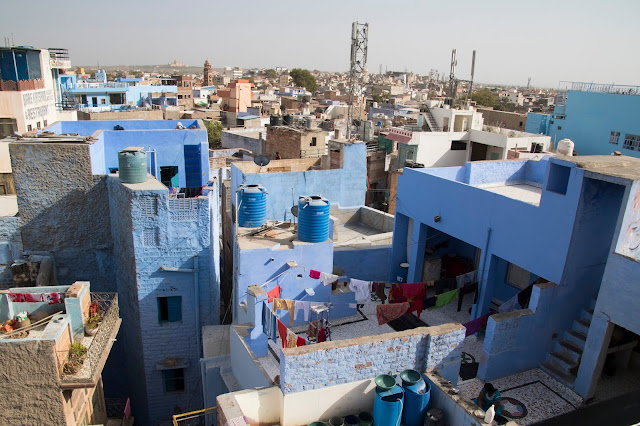 |
| View from our balcony |
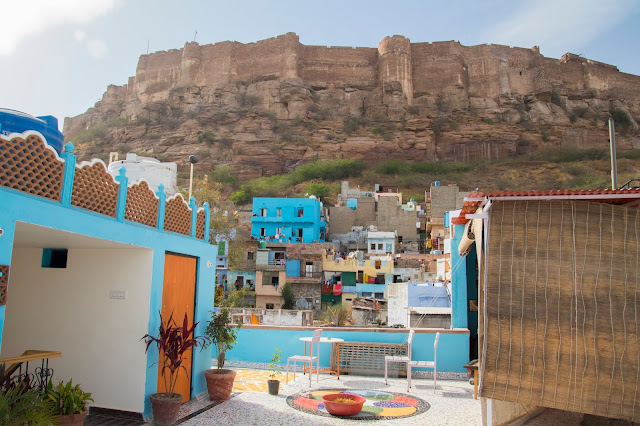 |
| Mehrangarh Fort behind our hostel from the rooftop restaurant |
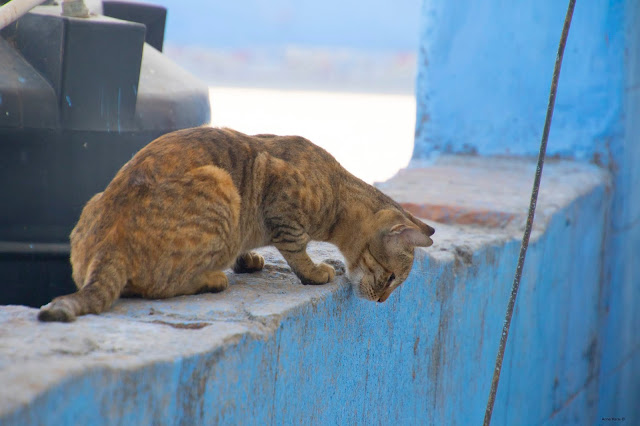 |
| Our balcony cat |
Jodhpur definitely
had a traveler vibe - backpackers have been coming here for decades - and it
shows in the amount of cafes, small restaurants, souvenir shops, tattoo
parlors and the occasional glitzy hotel. There were mopeds and autorickshaws everywhere, street cows grazing last nights' leftovers and an abundance
of homeless dogs. We had lunch at Namaste Cafe, rooftop restaurants being key
here, and spent the rest of the day wandering the streets. Jodhpur is a good
place for buying inexpensive textiles, if that's your thing.
 |
| Street goat |
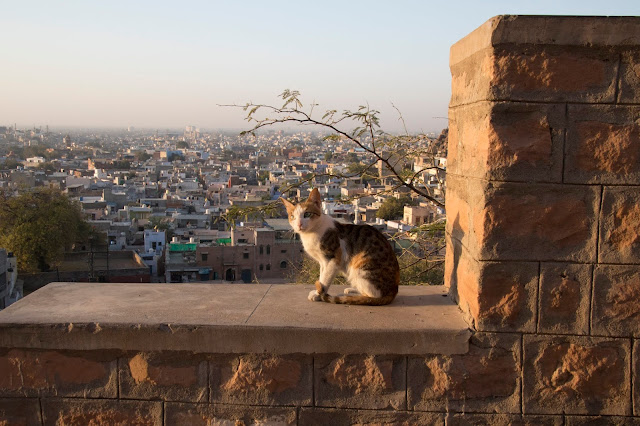 |
| Kitteh overlooks his city... |
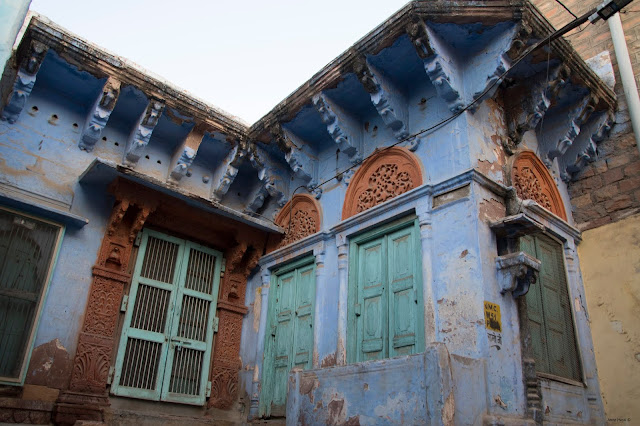 |
| Remnants of ancient splendor |
 |
| Sunrise over Jodhpur |
We spent the next
morning at the Rao Jodha Desert Rock Park, a bargain at 200 rupees entrance fee.
It's located behind the fort and you can easily walk there from the old city.
It took about 45 minutes and was all uphill but entirely worth the climb. Since
we went early in the morning to avoid the worst of the heat, it was just
opening as we arrived and during the entire time we only met one other couple.
It was beautiful, even though it was the dry season. There were lots of birds,
including quite a few green bee-eaters, purple sun birds, and some amazing
euphorbias. Definitely worth a visit for anyone interested in birds and plants.
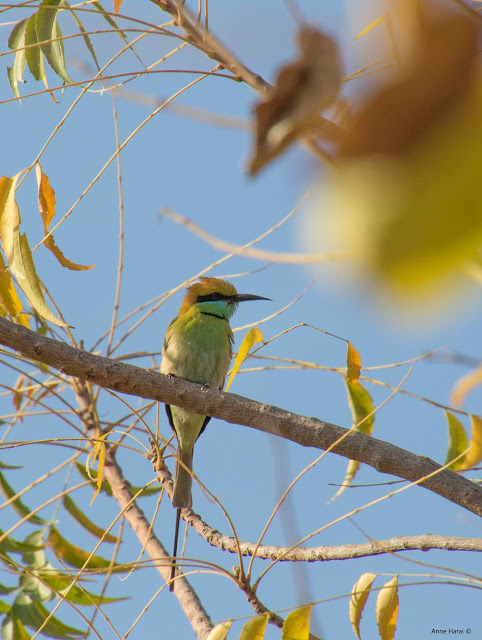 |
| Green bee-eater |
We had lunch at
Jhankar Choir-Haveli, a backpacker joint with a lovely courtyard garden and
very good pizza (yes, once in a while I need a taste of home), and some very
good lemonade. In the afternoon we walked down to Sardar Chowk, the crazy
market surrounding the clock tower, where just about everything is for sale from
colorful sari fabrics to toothbrushes, shoes, car parts and bags of paint
powder for the upcoming Holi festival. It was great for photos. The clock tower
itself is very pretty, "guarded" by a huge bull who seemed completely
oblivious to the madness going on around him. We bought samosas for dinner from
a little stand across from the guy selling bamboo scaffolding - Jodhpur is just a heaven for foodies.
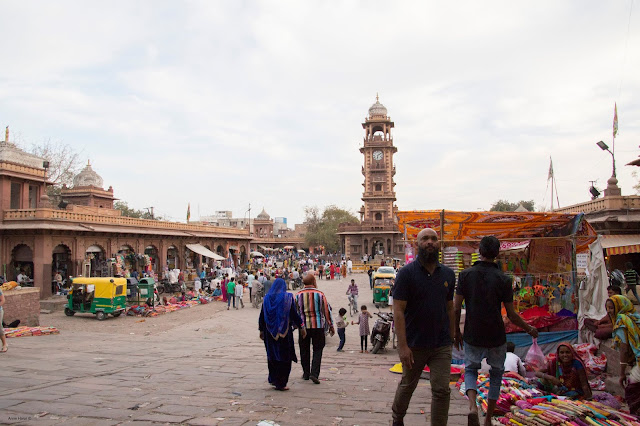 |
| Clock Tower and Sardar Chowk |
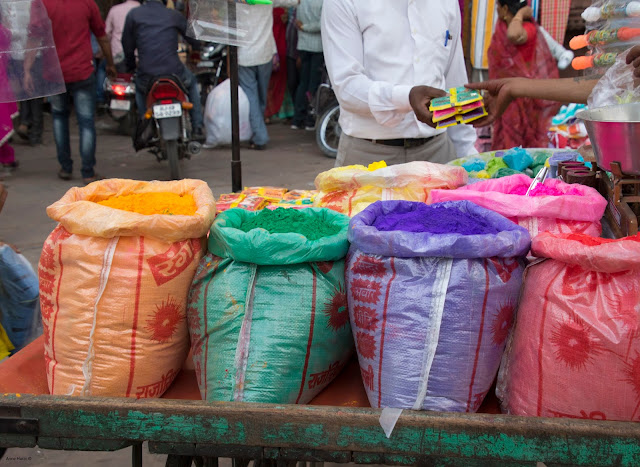 |
| Dye for Holi |
After a hearty breakfast of excellent banana porridge, I took an autorickshaw to Mandore, located 5 miles north of Jodhpur. It is the former capital of the Maharajas of Marwar and has an expansive garden containing the cenotaphs of Jodhpur's former rulers, built in red sandstone. It's well worth a visit, both for the rich Hindu architecture and the beautiful gardens, not to mention the Hanuman monkeys. I spent several hours photographing and only saw three other visitors and both were Indian, so maybe it had never made it into the guide books, which is really a shame. Lots of pretty birds, too, including a number of night herons.
 |
| One of the many temples |
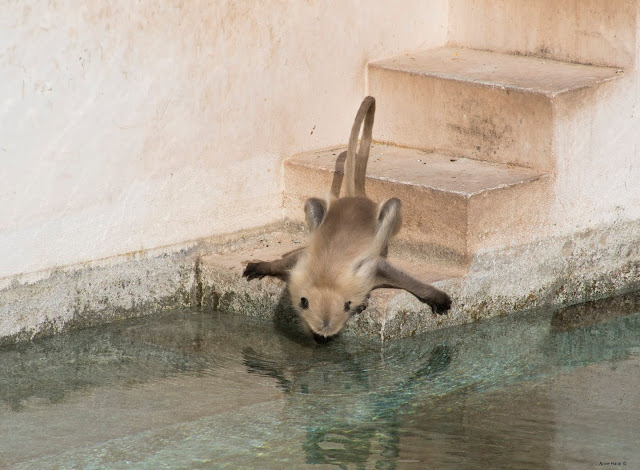 |
| Hanuman monkey at the sacred pool, Mandore |
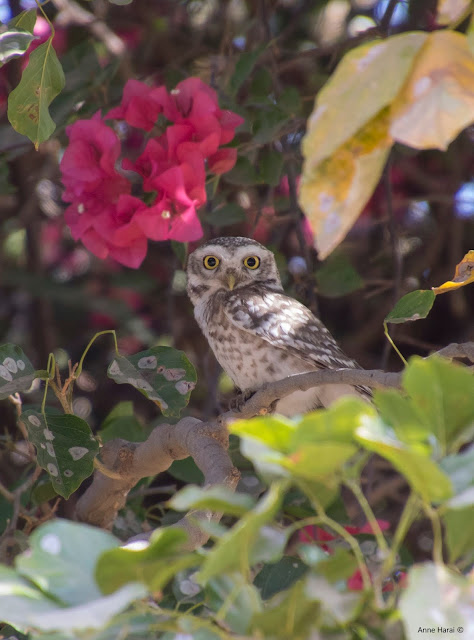 |
| Spotted owlet |
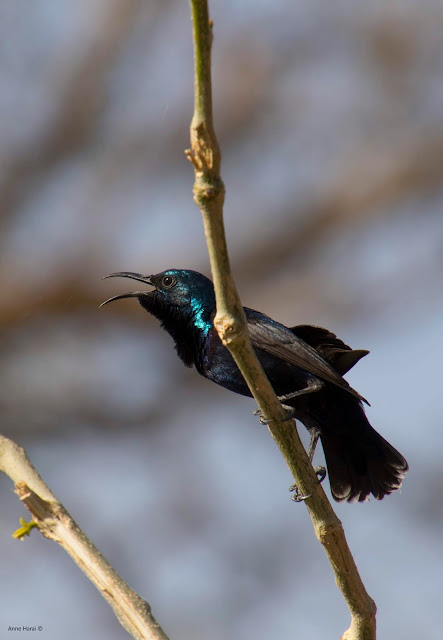 |
| Sunbird |
 |
| Mandore musician |
On the way back to the hostel, I stopped by the recently revived stepwell, which though not as impressive as the Jaipur stepwell, was still worth visiting.
And then I had a bit of a dinner disaster. Thinking I'd give my stomach a rest from spicy foods, I got a box of Kellogg's Special K and what I thought was milk from the corner shop, but it as not. The cereal was fine - until I doused it with green milk. Yes, green. I looked at the bottle - it said milk - but there was a picture of a cardamom pod and the bricks fell into place. Sweet, cloying cardamom milk. It did not go well with, well, probably anything really and I usually love cardamom. I went upstairs and had dal masala instead.
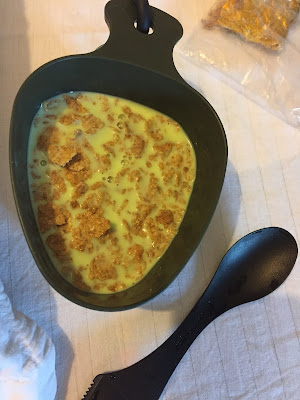 |
| Color not photoshopped... |
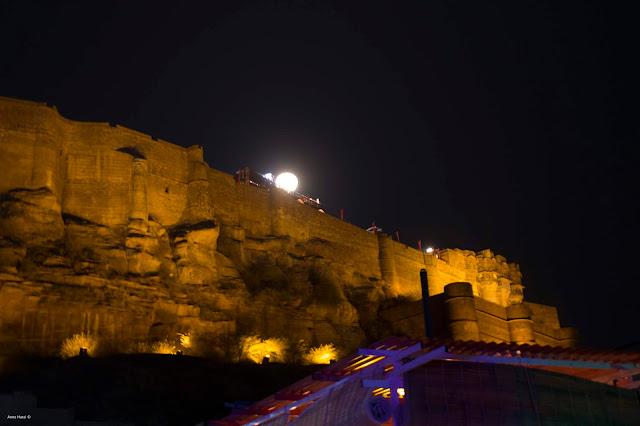 |
| The fort at night - not the moon but a huge balloon launched to look as if.... |
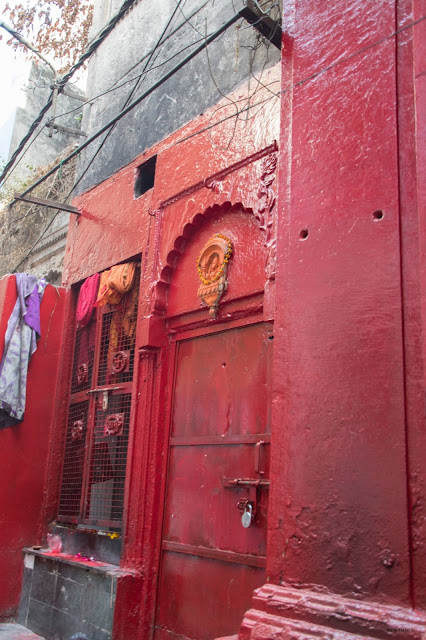
Speaking of culture shock, the next day we flew to Varanasi. We arrived late at night and the guy from the guesthouse who came to pick us up grabbed both of our backpacks and, despite our protestations, slung them both over his back and took off down the near dark alleys of the oldest city in India with a speed that would have put a marathon runner to shame. George and I struggled to keep up, simultaneously looking for our guy while trying very hard to see where, and what, we stepped in. I walked into a holy cow - it glared at me unaffected - then as if to teach me a lesson it left a souvenir, which George slipped in. It was an interesting hike. Fortunately, the guy slowed occasionally to make sure we were still there. Of all the odd experiences we had in India, this was the most surreal - between the maze of alleyways, the near darkness, the ancient men crouched in cubby holes smoking hash and looking at us in the light of tiny candles, the sounds of prayers and the penetrating smell of incense and wood smoke from the burning ghats, I felt both dizzy and exhilarated by the time we reached the guesthouse. A well-deserved rest would soon set us right, at least until the balcony monkeys started fighting.
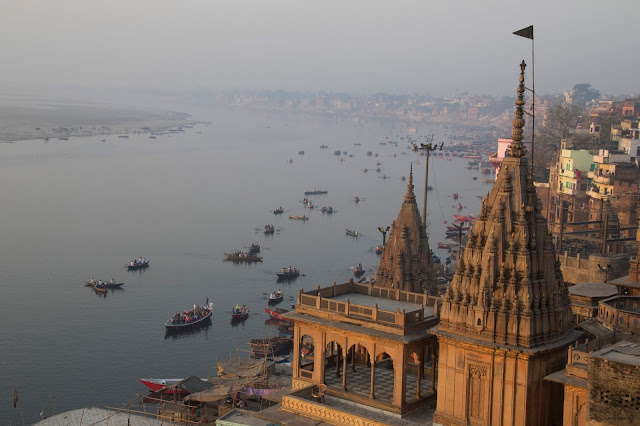 |
| View from our balcony |
Varanasi is one of the world's oldest continually inhabited cities and the birthplace of Shiva; the pilgrims that have flooded to this sacred site to wash away their sins in the revered waters of the Ganges or cremate their dead by its banks number in the millions. Our guesthouse, Schindia, was located very near the main funerary ghat, Manikarnika, with a great view over the river and in the quieter end of Old Town, meaning that it was blessedly some ways away from the very lively, all-night prayer and party ghat at Dashashwamedh.
Sunrise over the Ganges was beautiful. It was nice to stand on the balcony and watch the city wake up, surprisingly quiet in the early hours of morning. Next door at Manikarnika ghat the cremations were already going - it's an all night all day affair. In front of the steps, boats crammed with firewood and wood sellers crowded the water. Cremations are priced by weight and type of wood, sandalwood being the most expensive. The bodies are carried through alleyways by doms (outcasts) on bamboo stretchers and elaborately decorated with colorful saris and marigolds. We met several on our walks through the Old Town. Life and death is very close in Varanasi. It's weird how quickly you get used to it.
 |
| Manikarnika ghat |
Compared to other places, the touts were not bad. People were mostly busy doing their own thing, bathing, praying, performing the morning ablutions. It was nice wandering around and surprisingly quite that early. It got busier as the morning wore on and by noon the streets were downright crowded with people, dogs and cows. For lunch we found Raga Café - being in need of a non-vegetarian meal for once - and had excellent Korean food and some very tasty ginger lemonade.
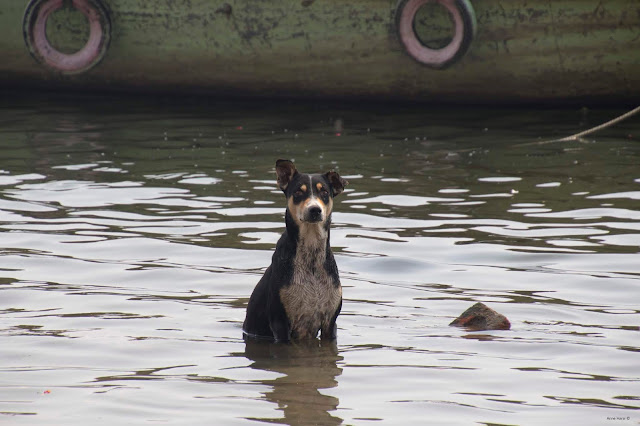
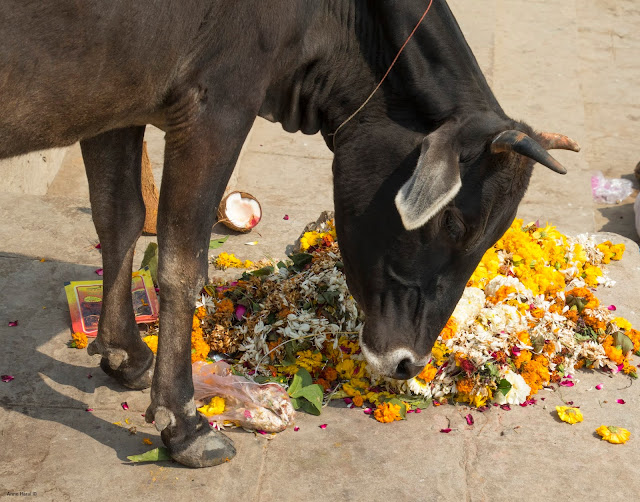
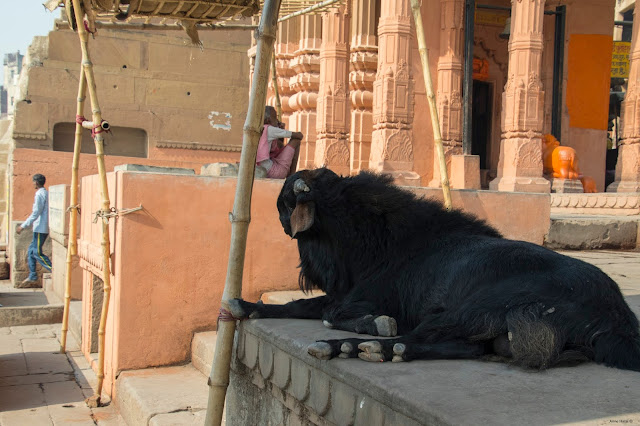
Once the sun set and the sweltering heat was less oppressive we walked down to Dashashwamedh Ghat, which was far more crowded, both with locals, holy men, tourists and touts. The evening ganga aarti ceremony takes place here and you could barely see the river for the sheer number of boats full of worshippers. What a spectacle! I felt like bit of a contortionist trying to avoid the old men thrusting fingers towards my face so they could paint my forehead and "bless" me and then demand money. We did buy a little offering of marigolds and a candle from a young girl and set it into the water. It's hard not to be moved by the sheer holiness of this city, even for a heathen like me. Having had our fill, we started making our way back past rows of platforms covered by colorful parasols and richly decorated with colorful symbols and incense dishes; this was where the sadhus sat, holy men who have renounced the worldly life and are high revered by Hindus. I found them very beautiful.
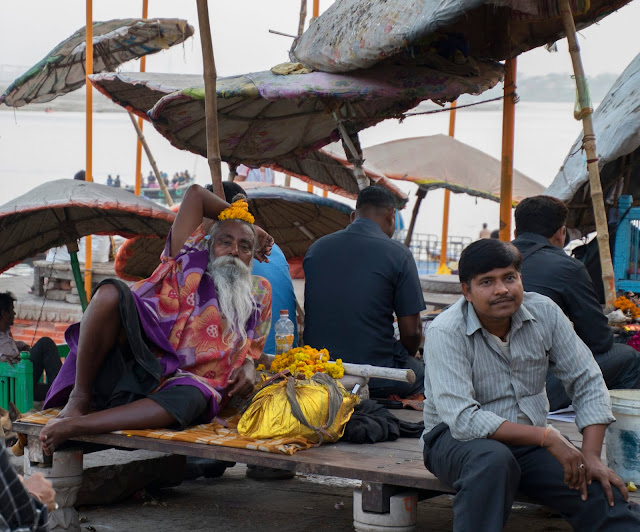 |
| Sadhu at Dashashwamedh Ghat | |
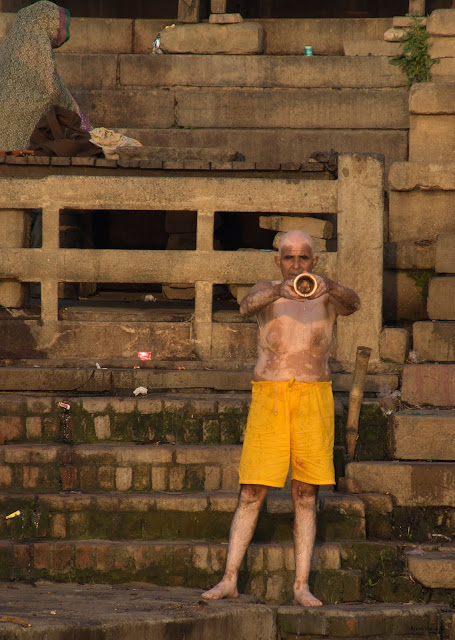 |
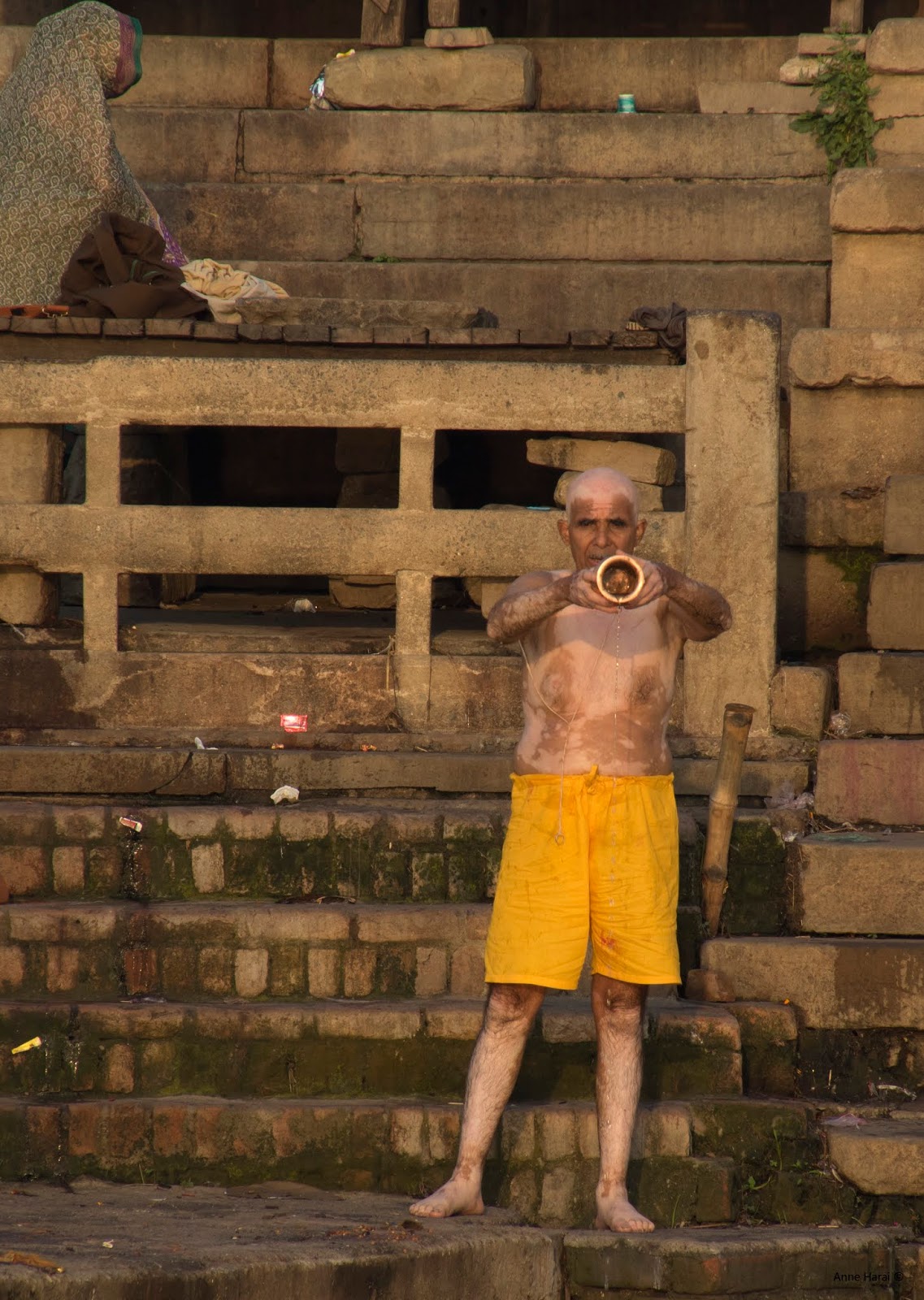
| Morning ablutions at the river's edge |
The following day was my birthday and, coincidentally, Holi. We spent the morning on the balcony watching hordes of young and old men partying along the river. At the advice of the hostel owner, we took a boat ride to see the partying instead of walking back to Dashashwamedh - he warned us that women should not be out on the streets because the drunken revelers usually got rather rowdy and grabby. We easily found a boatman, paid him 500 rupees for a hour and started off downriver. It was entertaining to watch the thousands of people celebrating from afar - the boom box blaring dance music through what must have been gigantic speakers made it sound like a Kuta Beach dance party. It was fun to watch. From afar.
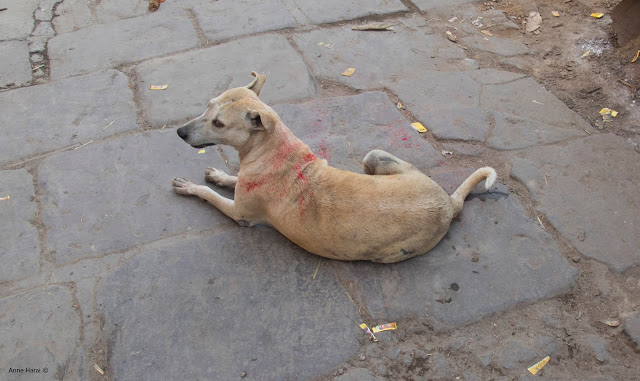 |
| Even the stray dogs got Holi dyed |
 |
| Washing the Holi dye off |
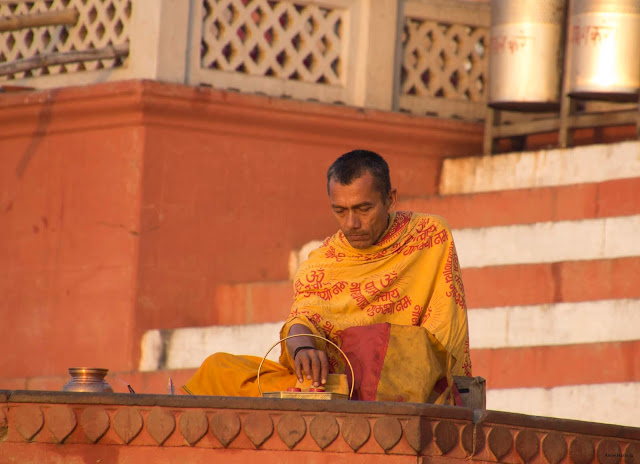 |
| Outside
the nearby Nepalese temple |
 By noon, it was pretty much over in our end of town so we went back to the Korean place and had delicious fried chicken in spicy pepper sauce. It was one of the only places that were open because of the holiday. We did another boat
ride that evening and watched the revelers along the river but by then it had
gone pretty quite, just loud music.
By noon, it was pretty much over in our end of town so we went back to the Korean place and had delicious fried chicken in spicy pepper sauce. It was one of the only places that were open because of the holiday. We did another boat
ride that evening and watched the revelers along the river but by then it had
gone pretty quite, just loud music.
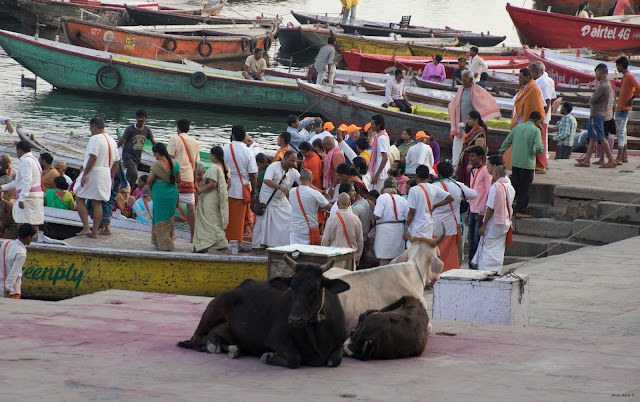 |
| Arrivals for the evening ceremony |
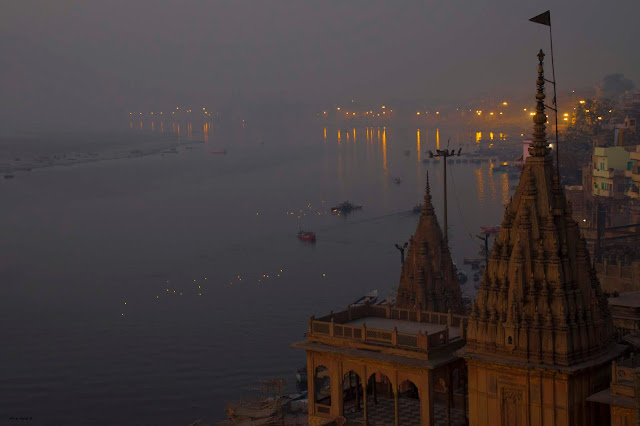 |
| Evening on the great Ganga |
We asked to be
dropped off near Scindhia Ghat and went in search of dinner. We walked into a
building where a bunch of old men welcomed us and pointed us upstairs, grinning
and making hand signals for eating - totally made me think of the guys in
"Cheers." And that's how we ended up at Sankatha Café. It's a very
unassuming rooftop restaurant, nothing fancy, just the usual plastic tables and
chair, with a view of the city and monkeys careening down the power lines and
tempting fate along the walls. The food, however, was divine. I had thali, the
typical Indian spread of dosa, naan, pickled limes, raita, masala, lentil soup,
cucumbers and pilaf, and George had chana masala. We were the only guests and
stayed a long while, entertained by the monkeys. It was our last night in
Varanasi and though it was fascinating, it would be nice to head down south.
One more restaurant to visit, though.
 |
| Kite runner next to the hostel - he was up there every morning |
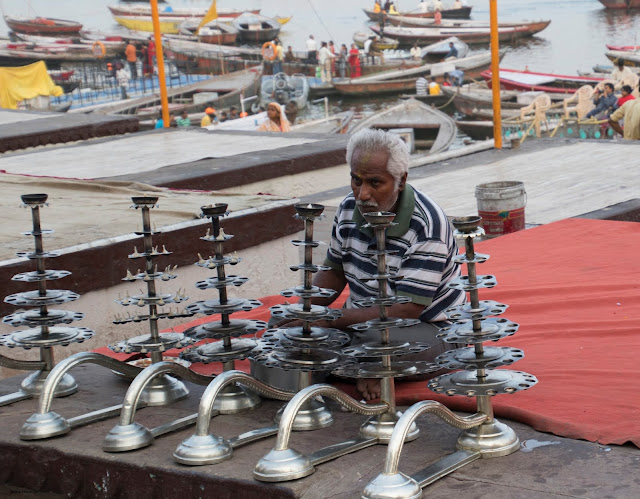 |
| Musician at the ghat |
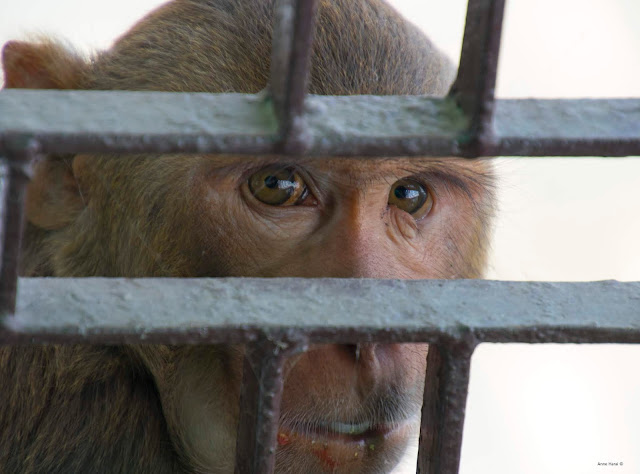 |
| Our balcony monkey |
Next morning we
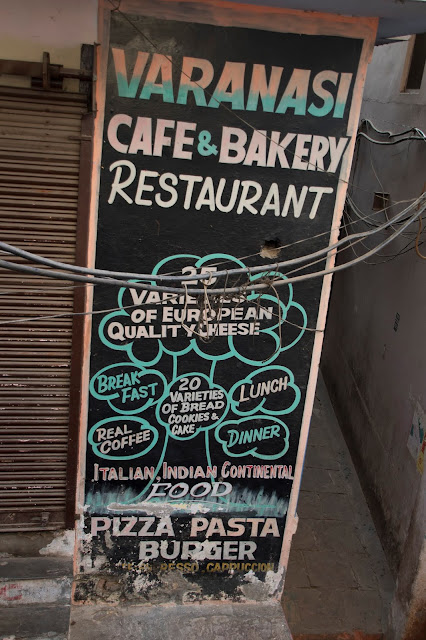
walked down to have breakfast at Varanasi Café & Bakery. Since it was Holi
the day before, the waiter had been partying late and his mom kicked him into
shape and finally decided to step in. She was delightful and the food was
wonderful. The coffee, served in a little clay cup and strong as an ox, was the
best I've had in all of India. I had banana pancakes that were excellent, and
also tried the brown bread (whole wheat to Americans) that was very good and
served with papaya jam. Highly recommend this place, for all the right reasons.
We flew to Kochi
that afternoon, a world away both in terms of climate and atmosphere. Kochi is
in Kerala, one of the southern states on the Arabian Sea and home to vast spice
and tea plantations. It felt like going from a crowded desert to the tropics; it
could have been anywhere in Indonesia, so stunning were the similarities. The
common theme were the mopeds, honking and incessant traffic but other than that
it seemed a different country entirely. There were lush palm trees and greenery
everywhere. Kerala is home to a maze of beautiful backwaters. For me, it was
love at first sight. We had emailed the hostel for an airport pickup - this is
the best idea ever - and were met by a nice driver who took us to one of the
best hostels I've ever stayed in, the Greenwoods Bethlehem. The owner is a
wonderfully warm lady called Sheeba (as in Queen of...) and her whole family
takes care of their guests as if they're long lost relatives. We came in late
at night and she still made time to make us tea and hug us both. The guesthouse
is set in a beautiful garden full of chickens and flowers, a haven after the
dusty alleys of Varanasi.
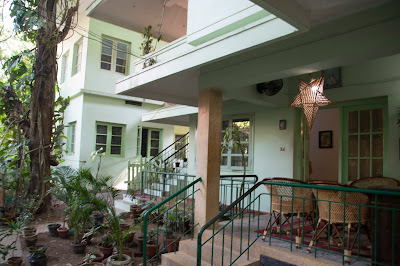 |
| Greenwood Bethlehem hostel |
Breakfast at the
Greenwoods Bethlehem was as lovely as its hosts - coconut pancakes, eggs, fresh
papaya, bottomless coffee and tea served on a spacious rooftop patio. The rooms
are beautifully decorated and there were several commons spaces, including some
very pleasant verandas and places to sit and watch all the birds. We took a
nice long walk in town and walked along the beach to see the cantilevered
Chinese fishing nets, one of the main attractions in Kochi. It's not really a
swimming beach but it was fascinating to watch the nets in action and there
were lots of stalls selling fresh fish and fruit and pickled mango, one of my
favorites.
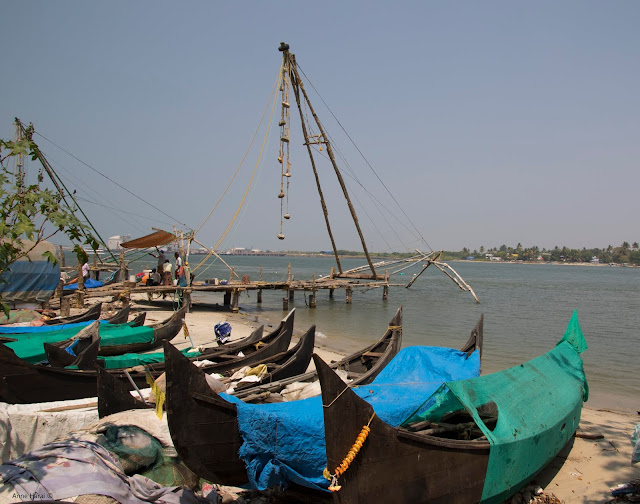 |
| Boats and the cantilevered fishing net |
Everything was
different from the north from the climate to the religion; Kochi has one of the
largest Christian populations in India as it initially settled by Dutch spice
traders. It was an interesting blend of Dutch, Portuguese and English
architecture, blended with mosques and synagogues. There were lots of pretty murals as well, mostly down the alleyways.
For lunch we went
to Kashi Art Café, a little gem of a restaurant with a nice atmosphere and very
tasty food. The ginger lemonade was lovely. There were quite a few little shops
in that area, selling anything from baked goods to beautiful sarongs, and a
central theater that had evening performances in ancient martial arts.
In the evening, I
went to a Kathakali performance at the Kerala Kathakali Cultural Center.
Tickets were a mere 350 rupees. The Kathakali is an ancient Indian dance
distinguished by the elaborate costumes and face paint worn by the performers
and was predominantly a Hindu performance art in this area. What was just as
good as the performance itself was the fact that they opened the doors early so
that we could sit and watch them apply their makeup on the beautiful carved
wood stage. It's clearly meant for art-interested tourists but was well worth
it. From a photographer's standpoint, it was an excellent opportunity for some
very unique shots since the majority of the performance is done by means of
facial expressions.
The food of Kerala
is highly focused on seafood and we had an excellent selection at Oceano
Restaurant in the downtown area. At a total of $20, it was the most expensive
dinner we had had and it was good enough for a repeat the following day. The
Kerala shrimp curry divine, not to mention the fish fry. Ginger lemonade is not to be missed here or
really anywhere.
The last day in
India was spent on a rice boat. They used to transport rice through the
backwaters of Kerala but have since been converted to serve as tourist boats. I
arranged for a tour through the hostel and was picked up the following morning
in a minibus along with several other backpackers from other hostels and taken a
couple of hours south to Alleppey. From here, the now eight passengers were
loaded into a converted rice boat, along with a guide and an oarsman and a
large set of tiffins containing our lunch, and we set off down the river. It
was a very pretty tour, both along the main waterway and in between the narrow
canals, watching the land slip by and the occasional working boat filled with
river grass. We encountered a swimming checkered keel-back snake, lots of birds
and the odd turtle here and there. We only got stuck only once and stopped on
one of the islands for a delicious lunch of vegetable thali and rice, where we
also had a little tour of the spice garden. It was all very informal and
low-key, no one was pushing us to buy anything and the guide knew a lot about
the islanders and their way of life.
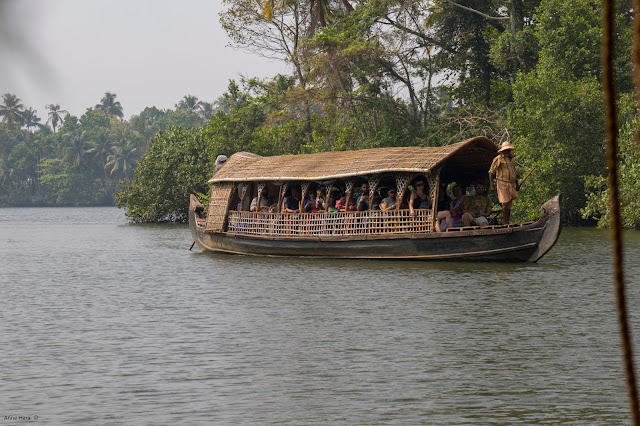 |
| Converted old rice boat |
 |
| Tiffins with lunch |
We got back to the
pier around 3 o'clock, had some snacks and then were taken back through the
busy business section of Kochi before reaching our quiet little guesthouse.
Dinner at Oceanos was piri-piri prawns with pineapple chutney and pilaf. We
finished off our India trip with excellent fresh fig panna cotta and boatloads
of vanilla kulcha, a nod to Kerala's excellent cuisine.
So that was the end
of my journey and exploration of this fascinating, maddening and wonderful
place. I did not know what to expect but I definitely left with an undeniable
need to see more. I liked India but I loved the south and did not see enough of
it; that part of the country is huge and fascinating and must be experienced - so some day I'm coming back to see the
rest. Despite the influx of tourism and progress, I have a feeling that the
India I fell in love with will always be there, hiding just under the surface
of the next Starbucks.